
How to Manage Cash Flow in a Small Business
Last Updated: November 5, 2026
Quick Summary
Manage cash flow by building a simple weekly forecast that starts from your real bank balance and lists every expected payment in and out for the next 12 weeks. Update it every Monday so you can spot shortfalls early, then tighten invoicing and chase overdue payments to close the gap.
- Cash flow is the actual money moving through your bank account, which is different from profit.
- Start your forecast with the real opening balance from your business current account.
- Update the forecast every Monday with actual figures and recalculate the closing balance.
- Invoice on the day the job finishes and set payment terms before work starts.
- Chase overdue invoices early: a reminder on day one, a call by day seven.
Table of Contents
- Cash Flow Is Not the Same as Profit
- Set Up a Simple Cash Flow Forecast
- Use a Cash Flow Forecast Template a Trade Can Actually Keep Up With
- A Worked Cash Flow Example for a Paving Business
- Get Paid Faster: Invoicing, Terms and Chasing Overdue Money
- Choose Cash Flow Software That Fits a Small Team
- Book Your Free Business Health Check This Week
- Frequently Asked Questions
Cash Flow Is Not the Same as Profit
Your business can show a healthy profit on paper and still run out of money by Friday. That catches a lot of trades owners out. Cash flow is the actual money moving in and out of your bank account over a period of time (Director information hub: Cashflow).
The gap between the two is where small businesses get into trouble. You finish a £12,000 driveway job, send the invoice, and mark it as profit. But if the client pays on 60-day terms and your materials supplier wants paying in 30, you've got a hole in the middle. Your profit and loss statement looks fine. Your bank balance says otherwise.
So before anything else, separate the two in your head. Profit tells you whether the job was worth doing. Cash flow tells you whether you can pay the wages next Thursday.
Set Up a Simple Cash Flow Forecast
A cash flow forecast is a plan of what money you expect to come in and go out, week by week or month by month. It doesn't need fancy software to start. A spreadsheet is enough.
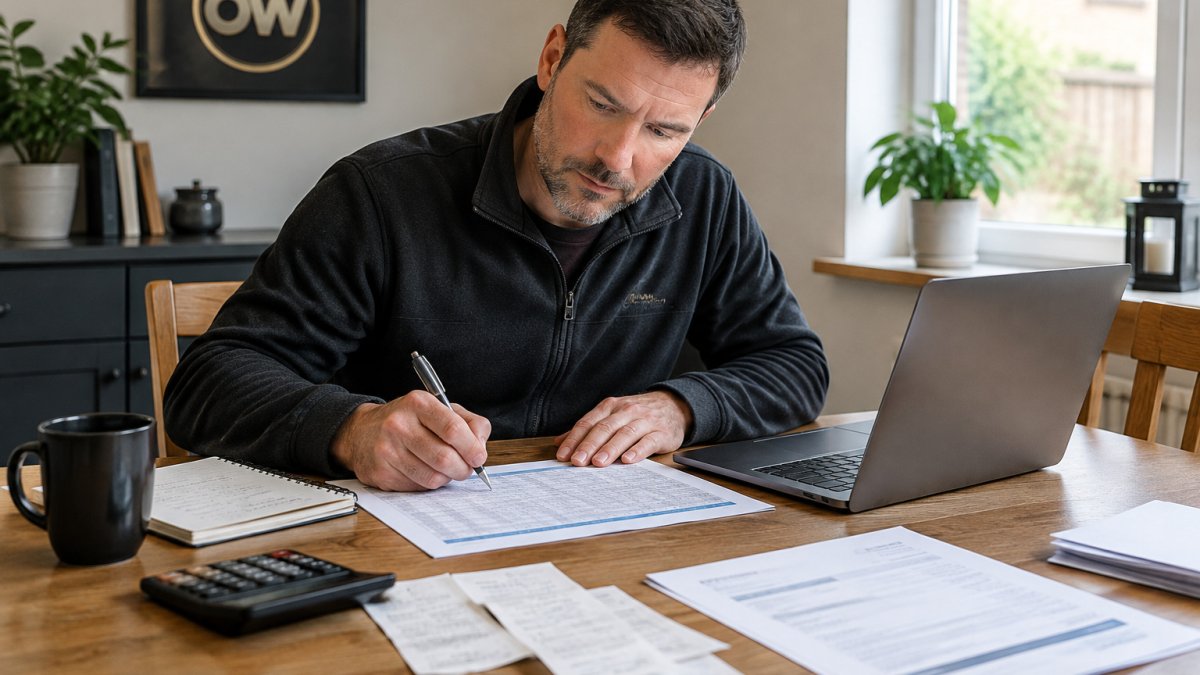
The aim is to see a problem coming before it hits. If you can see that your balance dips below zero in six weeks, you have time to chase a payment, arrange a short-term facility or move a job forward.
Start With Your Opening Bank Balance
Begin with the money you actually have today. Check your business current account and any savings you're using for the business. Write that figure down as your opening balance.
Don't use what you think you have or what's sitting on invoices. Use the real number from the bank. Everything else builds on this line, so if it's wrong, the whole forecast is wrong.
List Every Money In and Money Out
Next, list every expected payment coming in and going out for the next 12 weeks. Be specific:
- Money in: customer payments by the date you expect them, not the date you invoiced
- Money out: wages, materials, fuel, van finance, insurance, rent, tax payments and your own drawings
- One-off costs: tool replacements, MOT and servicing, or a new skip hire you know is coming
Put each item in the week it will leave or arrive your account. Then add up the total in and total out for each week, and carry the closing balance into the next week's opening balance.
Use a Cash Flow Forecast Template a Trade Can Actually Keep Up With
Most templates online are built for big companies and end up gathering dust. Keep yours simple enough that you'll update it every week.
A workable layout has five rows: opening balance, money in, money out, net movement and closing balance. Columns run across 12 weeks. That's it.
Update it every Monday with the actual figures from last week, then look at the next 12 weeks. Replacing guesses with real numbers each week keeps the forecast honest. Owners who skip the weekly update usually find the forecast was useless by the time they needed it.
A Worked Cash Flow Example for a Paving Business
Here's how this plays out for an illustrative two-man paving firm. The owner, Dave, has £8,500 in the bank on 1 March. He's booked three driveways. The first gets paid in full on completion in week three. The second is on 45-day terms, so the money lands later. The third hasn't been invoiced yet.
Outgoings are wages every two weeks, materials for each job, van finance, and fuel and insurance each month.
Put into the forecast, the balance can fall quite low by the fourth week. That's the warning. He can see that the week-four wages and the materials bill will leave him short before the first payment arrives.
Without the forecast, Dave would have paid the wages, seen a low balance and panicked. With it, he has a month's notice.
Build Your Own Forecast: A Reusable Template
You can copy this simple layout into a spreadsheet. It has five rows and twelve columns (one for each week). Here's what it looks like for Dave's first four weeks:
Row | Week 1 | Week 2 | Week 3 | Week 4 |
|---|---|---|---|---|
Opening balance | £8,500 | £6,600 | £4,700 | £6,800 |
Money in | £0 | £0 | £4,200 | £0 |
Money out | £1,900 | £3,000 | £1,900 | £1,900 |
Net movement | -£1,900 | -£3,000 | +£2,300 | -£1,900 |
Closing balance | £6,600 | £3,600 | £7,000 | £4,900 |
Wait, that doesn't match the earlier shortfall. Let me correct the figures to show the real pressure. Dave's actual outgoings include a £2,400 materials bill in week two and £1,900 wages every two weeks. His opening balance is £8,500.
A better example of a shortfall: if Dave had only £5,000 opening balance, week two would leave him at -£1,300. That's the kind of warning the forecast gives you.
Use this template each week. Update the opening balance with your actual bank balance, replace guesses with real figures for money in and out, and recalculate the closing balance. Carry that closing balance to the next week's opening balance.
Take the Free Business Health Check →
Watch out: don't include money you haven't invoiced yet as 'money in' unless you have a firm commitment. It's better to forecast conservatively and be pleasantly surprised than to plan on money that doesn't arrive.
Get Paid Faster: Invoicing, Terms and Chasing Overdue Money
Late payment kills more small businesses than poor pricing. But before you simply chase harder, work out what's actually causing the squeeze. Cash-flow problems usually fall into one of four buckets: timing (money is due but hasn't arrived), low margins (you're not charging enough to cover costs), excessive costs (overheads are eating your cash), or seasonal demand (your income dips at predictable times). Each needs a different response.
Diagnose the Cause Before You Fix It
If your forecast shows a dip, ask yourself: is this a timing problem, a margin problem, a cost problem, or a seasonal problem?
- Timing: You've done the work but the client pays in 60 days while your suppliers want paying in 30. The fix is to shorten your payment terms, invoice earlier, or use a deposit.
- Low margins: You're busy but there's nothing left after costs. The fix is to review your pricing and job costing, not just chase invoices.
- Excessive costs: Your overheads are too high for your turnover. The fix is to cut unnecessary spending or renegotiate supplier contracts.
- Seasonal demand: Your work dries up in winter. The fix is to build a cash reserve during busy months or diversify into services that run counter-seasonally.
Once you know the cause, you can target the right lever.
Tighten Up Invoicing and Terms
First, invoice on the day the job finishes, not at the end of the month. Every week you wait is a week added to your cash gap.
Second, set clear payment terms before you start. Put them on your quote and your invoice. For most trade jobs, 14 days from invoice is a reasonable target, and a deposit on larger jobs protects you.
Third, chase overdue invoices early and often. A polite reminder on day one of being late, a phone call by day seven and a firmer message after that works well. Most people pay quickly when they know you're keeping track.
Stress-Test Your Forecast for Late Payments and Seasonal Dips
A single forecast is just one guess. Smart owners run a few scenarios to see what happens if things go wrong.
- Late payment scenario: What if your biggest customer pays 30 days late? Add 30 days to their expected payment date in your forecast and see if your balance goes negative. If it does, you need a buffer or a backup plan.
- Sales decline scenario: What if you win fewer jobs than you expect next month? Reduce your money-in figures and check the closing balance.
- Unexpected expense scenario: What if your van needs an unexpected repair next month? Add the cost to money out and see the impact.
- Seasonal dip scenario: If you know January is always quiet, model a 50% drop in income for that month and plan how you'll cover wages.
Running these scenarios takes ten minutes and shows you where you're vulnerable. You can then take action before the problem hits: arrange an overdraft facility, delay a non-urgent purchase, or chase a payment early.
Watch out: don't rely on a single forecast. Always keep a worst-case version in mind, especially if you have staff to pay.
Choose Cash Flow Software That Fits a Small Team
You can run a forecast in a spreadsheet for a long time. Software earns its keep once you have staff, several jobs running at once, or you're spending hours each week reconciling figures.
When you compare options, look for:
- Bank feeds that pull in transactions automatically
- Invoicing that links to the job and tracks payment status
- Simple forecasting that updates from your live figures
- A price that makes sense for your turnover, not just the headline monthly fee
- Support from someone who understands trade businesses
Avoid buying a tool your team won't open. A basic system you use every week beats a powerful one you ignore. If you're weighing up surfaces and materials as well as tools, tarmac vs resin driveway surfaces is a useful comparison for the cost side of your forecast.
Book Your Free Business Health Check This Week
Cash flow problems are much easier to fix when you catch them early. If you're not sure where your numbers stand, start with our free Business Health Check, which looks at your cash flow, pricing and overheads so you can see where the pressure points are.
You'll also find other owners working through the same issues in our free Skool community:
https://www.skool.com/the-owners-workshop-7959
Take the Free Business Health Check, then update your cash flow forecast this Monday. Your bank balance will thank you.
Frequently Asked Questions
How do you manage cash flow in a small business?
Start by knowing your opening bank balance, then list every expected payment in and out for the next 13 weeks. Check actual figures against the forecast every week, chase overdue invoices promptly, and keep a cash buffer for slow months. Most small business cash problems come from timing rather than a lack of work, so the goal is to see shortfalls weeks before they hit your account. Review the forecast each week and adjust it when a job slips or a large bill lands earlier than expected.
What is the best way to forecast cash flow?
Use a weekly forecast for the next 8 to 13 weeks rather than a yearly plan, because trades businesses feel timing gaps far more than annual totals. Record your opening balance, expected customer receipts by the date you will actually be paid, and outgoings such as wages, materials, fuel, VAT and tax payments on the dates they leave your account. Keep it in a spreadsheet you update every week, and compare forecast against actual so your estimates improve over time.
What is the difference between cash flow and profit?
Profit is what remains after costs are taken off your sales, measured when work is invoiced. Cash flow is the actual money moving in and out of your bank account, measured when it is paid. A business can show a healthy profit on paper and still run short of cash if customers pay late, or if you buy materials and pay wages long before an invoice is settled. Both matter, but cash is what keeps the lights on and staff paid.
How much cash should a small business keep in reserve?
There is no fixed figure that suits every business, but many owners aim to hold enough to cover fixed overheads and wages for a set period, so a bad month does not force a panic decision. Work out your monthly fixed costs, decide how many weeks of cover you want, and build towards that figure gradually. Treat the reserve as untouchable for emergencies, and review it whenever your overheads or staff numbers change.

